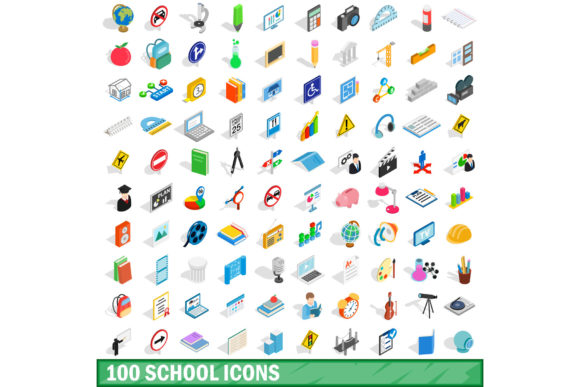
100 School Icons Set, Isometric 3d Style
Designing educational materials often feels like a balancing act. You want to convey information clearly, but you also need the visuals to be engaging enough to hold attention. Flat design has its place, but there is something inherently more tactile and immersive about depth. This is where the 100 School Icons Set, Isometric 3d Style steps in. It isn’t just a collection of clip art; it is a comprehensive visual toolkit designed to bring a sense of dimension and realism to digital and print projects without requiring complex 3D modeling skills.
The isometric style offers a unique perspective. Unlike standard flat icons that sit on a single plane, these icons are rendered with depth, using parallel projection to create a three-dimensional effect on a two-dimensional surface. The result is a set of graphics that look structured, organized, and modern. Whether you are building an e-learning platform, designing a classroom poster, or creating infographics for back-to-school marketing campaigns, this set provides the visual vocabulary needed to tell a cohesive story.
Bridging the Gap Between Abstract Concepts and Tangible Objects
Education can sometimes feel abstract. Concepts like "attendance," "library resources," or "science lab" are ideas until they are visualized. A well-designed icon bridges that gap. When you use the 100 School Icons Set, Isometric 3d Style, you are giving users concrete objects to interact with mentally. For instance, instead of a simple text label saying "Library," an isometric icon of a bookshelf with books slightly protruding creates an immediate mental image of space and content.
This approach is particularly effective for user interface (UI) design in educational apps. When students navigate a learning management system (LMS), cognitive load is a real factor. Clear, distinct visuals help reduce confusion. An isometric globe for geography, a microscope for biology, or a calculator for math allows users to scan menus quickly. The slight shadowing and angle of the isometric view provide subtle cues about hierarchy and interactivity, making the digital experience feel more responsive and polished.
Versatility Across Industries and Audiences
While the primary audience might seem to be educators, the utility of this icon set extends far beyond the classroom walls. The versatility of having 100 distinct, high-quality vectors means that various professionals can leverage these assets for different purposes.
- Educational Content Creators: Teachers and instructional designers can use these icons to break up dense text in lesson plans or slide decks. The 3D style adds visual interest that keeps younger audiences engaged without being distracting.
- EdTech Developers: For startups building school management software, consistency is key. Having a unified set of 100 icons ensures that every feature, from "Gradebook" to "Attendance Tracker," shares the same visual language. This professionalism builds trust with school administrators who are evaluating the software.
- Marketing Agencies: When promoting private schools, tutoring services, or summer camps, marketers need to stand out. The 100 School Icons Set, Isometric 3d Style offers a premium look that elevates brochures, social media ads, and landing pages. The depth in the icons suggests quality and thoroughness, which are desirable traits in the education sector.
- Print Designers: For those working on physical materials like yearbooks, school newsletters, or event flyers, the availability of vector formats (EPS, AI) ensures that the icons can be scaled to any size without losing quality. A large banner at a school fair will look crisp alongside small icons on a business card.
Technical Flexibility Meets Creative Freedom
One of the most significant advantages of this specific set is its format diversity. The inclusion of JPG, EPS, AI, PSD, and PNG files caters to different workflows and technical requirements. This flexibility is crucial for professional designers who need to integrate assets seamlessly into their existing processes.
For those working in Adobe Illustrator, the native AI and EPS files allow for easy editing. If a school’s branding color is a specific shade of blue rather than the default red in the icon set, designers can open the vector file and adjust the colors directly. This level of control is impossible with raster images like JPGs or standard PNGs. Similarly, the PSD files are beneficial for Photoshop users who may need to add custom textures, shadows, or lighting effects to match a broader design theme.
The PNG files, typically provided with transparent backgrounds, are perfect for quick insertions into web designs or presentation software. They save time by removing the need to mask or cut out backgrounds manually. Meanwhile, JPG files offer a lightweight option for web optimization when transparency isn't required, ensuring fast loading times for online portals.
Practical Considerations for Implementation
Before integrating the 100 School Icons Set, Isometric 3d Style into a project, it is helpful to consider how these assets will function within the broader design ecosystem. Consistency is paramount. Because all 100 icons share the same isometric angle and rendering style, they naturally complement each other. However, mixing them with flat icons or photorealistic images can create a jarring visual disconnect. To maintain a professional aesthetic, it is best to keep the design language uniform throughout a single project.
Another consideration is scale. While isometric icons look great at medium sizes, extremely small sizes can sometimes lose their detail due to the added complexity of the 3D rendering. In mobile interfaces, for example, it is wise to test the icons at actual display sizes to ensure readability. If an icon becomes too cluttered at a tiny resolution, simplifying the design or choosing a less detailed icon from the set might be necessary.
Color customization is another area where careful planning pays off. The 3D style relies heavily on shading and highlights to create depth. When recoloring icons, it is important to preserve the light source direction. Changing a dark blue object to bright yellow without adjusting the shadows can make the icon look flat or unnatural. Using the vector files allows designers to manipulate gradients and shadows to maintain the illusion of depth regardless of the chosen color palette.
Enhancing Communication Through Visual Hierarchy
In an era where attention spans are short, visual hierarchy is a powerful tool. The 100 School Icons Set, Isometric 3d Style helps establish clear priorities in design. Larger, more detailed icons can draw attention to key features or important announcements, while smaller, simpler icons can serve as secondary indicators. This stratification guides the viewer’s eye through the content logically.
For example, in a dashboard for student progress, the main performance chart might be accompanied by a large, prominent isometric trophy icon for achievements, while minor updates could be marked with smaller icons for homework or attendance. This visual distinction reduces the cognitive effort required to process information, allowing users to grasp the overall status of their academic journey at a glance.
A Investment in Quality and Efficiency
Creating custom 3D illustrations for every element in a school-related project is time-consuming and expensive. Sourcing individual assets from multiple libraries often leads to inconsistent styles, forcing designers to spend hours tweaking shapes and colors to make them fit together. The 100 School Icons Set, Isometric 3d Style solves this problem by providing a cohesive, ready-to-use library.
By opting for a comprehensive set, designers and developers save valuable time that can be redirected toward strategy and creativity. The assurance that 100 different scenarios—from "art class" to "school bus"—are covered means fewer gaps in coverage and fewer compromises on quality. It is a practical solution for anyone looking to elevate their educational designs with modern, engaging, and versatile visuals.