100 Excellence Icons Set: A Comprehensive Evaluation for Designers
In the modern digital landscape, visual communication is paramount. Whether designing a corporate dashboard, a mobile application, or a marketing website, icons serve as essential navigational aids and aesthetic anchors. Among the various resources available to designers, the 100 Excellence Icons Set has emerged as a notable option for those seeking high-quality vector illustrations. This collection, which includes both standard flat designs and a specialized 100 excellence icons set in isometric 3d style, offers versatility for a wide range of projects. However, selecting the right asset library requires careful consideration of format compatibility, stylistic consistency, and specific use-case requirements.
This article provides an objective evaluation of the 100 Excellence Icons Set. It explores what the product entails, analyzes its technical specifications, and discusses the practical implications for designers evaluating it for their workflow. The goal is to help readers determine whether this icon set aligns with their professional needs.
Understanding the Product Scope
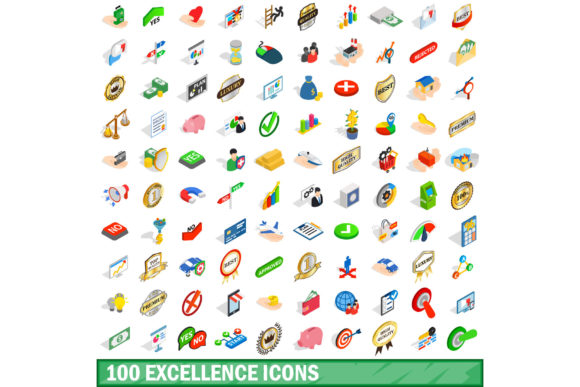
The core offering of the 100 Excellence Icons Set is a curated collection of one hundred distinct graphical symbols. These icons are designed to represent concepts related to achievement, quality, performance, and success. Common themes within such sets typically include trophies, medals, upward-trending graphs, checkmarks, stars, and abstract representations of excellence. By focusing on a specific thematic niche rather than a generic utility set, this collection allows designers to maintain a cohesive narrative in their projects without needing to mix disparate styles.
A significant differentiator of this product is the inclusion of two distinct visual treatments. In addition to the primary iconography, the package features a 100 excellence icons set in isometric 3d style. Isometric design has gained substantial popularity in recent years due to its ability to create depth and dimensionality without relying on complex perspective distortion. This dual-offering means that users receive not just a single style, but a complementary pair of styles that can be used together to create visual hierarchy or contrast within a single interface.
Technical Specifications and File Formats
For professional designers, the availability of source files is often more critical than the visual appearance of the final output. The 100 Excellence Icons Set supports a comprehensive array of formats, ensuring compatibility across various software ecosystems. Understanding these formats helps users assess the value proposition of the purchase.
- EPS (Encapsulated PostScript): This is a industry-standard vector format widely supported by Adobe Illustrator, CorelDRAW, and other professional graphic design tools. EPS files allow for infinite scalability without loss of quality, making them ideal for print media and large-scale displays.
- AI (Adobe Illustrator): As the native format for Adobe Illustrator, AI files provide full access to editable layers, paths, and color swatches. This is particularly valuable for designers who need to customize the icons to match specific brand guidelines or adjust stroke weights.
- PSD (Photoshop Document): For designers working primarily in raster-based environments, PSD files offer pixel-perfect editing capabilities. This format is useful for applying layer styles, shadows, and gradients directly to the icons before exporting them.
- PNG (Portable Network Graphics): PNG files are raster images that support transparency. They are ready-to-use for web development, user interface (UI) design, and presentations where vector manipulation is unnecessary. High-resolution PNGs ensure crisp rendering on retina displays.
- JPG (Joint Photographic Experts Group): While less flexible than vector formats, JPG files are universally compatible and have smaller file sizes. They are suitable for quick previews or low-bandwidth web applications where transparency is not required.
The combination of vector (EPS, AI) and raster (PNG, JPG, PSD) formats ensures that the 100 Excellence Icons Set can integrate seamlessly into diverse workflows, from initial sketching to final deployment.
Benefits of Using the 100 Excellence Icons Set
One of the primary advantages of this icon set is its thematic cohesion. Because all icons revolve around the concept of "excellence," designers do not need to spend time searching for matching assets from different sources. This saves time and reduces the risk of stylistic inconsistency, which can detract from the professionalism of a design.
The inclusion of the 100 excellence icons set in isometric 3d style adds significant value. Isometric illustrations are currently trending in tech startups, fintech applications, and educational platforms. Having access to a complete set of isometric icons allows designers to create immersive, story-driven visuals that stand out in a crowded market. Furthermore, the ability to switch between flat and isometric styles gives designers flexibility in creating visual interest—for example, using flat icons for navigation and isometric icons for featured content.
Additionally, the vector nature of the EPS and AI files ensures future-proofing. As screen resolutions increase and printing technologies evolve, vector assets remain sharp and clear. This eliminates the need to repurchase assets when project requirements change or when scaling up from digital to physical media.
Tradeoffs and Considerations
While the 100 Excellence Icons Set offers many benefits, there are tradeoffs that potential buyers should consider. First, the thematic focus may be limiting. If a designer is working on a project that requires a broad range of UI elements—such as settings gears, home buttons, or search magnifying glasses—this set may not be sufficient. It is best suited for projects specifically highlighting achievement, progress, or quality metrics.
Secondly, the complexity of isometric designs can sometimes lead to usability issues if not implemented carefully. Isometric icons are visually heavier and can become cluttered at small sizes. Designers must ensure that these icons are used at appropriate scales, typically larger than standard flat icons, to maintain legibility. This requires thoughtful layout planning and may necessitate additional white space in the design.
Another consideration is the learning curve associated with editing vector files. While AI and EPS files offer maximum customization, they require proficiency in vector editing software. Users unfamiliar with path manipulation may find it challenging to modify the icons to fit their specific needs, potentially leading to frustration or suboptimal results.
Situational Fit: When to Choose This Set
The 100 Excellence Icons Set is a strong fit for several specific scenarios. It is particularly well-suited for:
- Corporate Dashboards and Analytics: Projects that display key performance indicators (KPIs), growth charts, and success metrics benefit greatly from the thematic relevance of excellence-oriented icons.
- Educational Platforms: Online courses and certification programs often need to highlight achievements, badges, and completion statuses. The isometric style adds a sense of prestige and accomplishment.
- Marketing Materials: Brochures, landing pages, and social media graphics that aim to showcase awards, rankings, or high-quality standards can leverage the premium feel of the 3D isometric variations.
- App Development for Fintech or Business: Applications focused on finance, business management, or productivity often use icons representing growth and success. The clean, professional aesthetic of this set aligns well with these industries.
When to Consider Alternatives
There are situations where alternative resources may be more appropriate. For general-purpose UI kits that require hundreds or thousands of diverse icons covering every conceivable function, a dedicated UI icon pack would be more efficient. Similarly, if a project demands a highly playful or hand-drawn aesthetic, the structured and geometric nature of the 100 Excellence Icons Set might feel too rigid or formal.
Furthermore, designers looking for free resources might explore open-source libraries like FontAwesome or Flaticon. However, these free options often lack the curated coherence and high-end isometric detail found in premium sets like this one. The choice ultimately depends on the balance between budget constraints and the need for unique, high-quality visual assets.
Practical Decision-Making Insights
To determine if the 100 Excellence Icons Set is the right choice, designers should evaluate their current project requirements against the following criteria:
- Thematic Relevance: Does your project center around achievement, quality, or success? If yes, this set is highly relevant.
- Style Requirements: Do you need both flat and 3D isometric styles? If you want to incorporate depth without creating assets from scratch, this set provides a ready-made solution.
- Technical Needs: Do you require editable vector files for customization? The availability of AI and EPS formats makes this set adaptable to custom branding needs.
- Budget vs. Value: Compare the cost of this set against the time saved by not creating icons manually. For professional designers, time efficiency is often a more valuable metric than the upfront cost of assets.
In conclusion, the 100 Excellence Icons Set represents a solid investment for designers seeking specialized, high-quality vector illustrations. Its combination of thematic focus, dual-style offerings, and robust file format support makes it a versatile tool for enhancing visual communication in professional contexts. By carefully assessing the specific needs of their projects, designers can leverage this resource to create polished, impactful designs that effectively convey messages of excellence and achievement.