100 E-learning Icons Set: A Comprehensive Evaluation for Designers
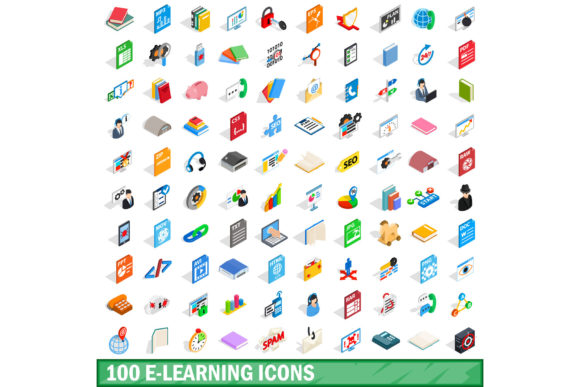
In the rapidly evolving landscape of digital education, visual communication serves as a critical bridge between complex concepts and learner comprehension. The 100 E-learning Icons Set represents a curated collection designed to address this specific need, offering a versatile toolkit for professionals creating educational content. This resource is particularly notable for its dual approach: it combines a standard flat iconography suite with an extensive 3D isometric variation, providing depth and modernity to user interfaces.
When evaluating design assets, the decision often hinges on more than just aesthetics; it involves workflow efficiency, file compatibility, and the ability to scale across various media. The inclusion of multiple formats—ranging from vector-based EPS, AI, and PSD to raster-friendly JPG and PNG—ensures that the 100 E-learning Icons Set fits seamlessly into diverse production pipelines. Whether you are building a Learning Management System (LMS), designing interactive courseware, or crafting marketing materials for an ed-tech startup, understanding the nuances of this set helps in making an informed selection.
Distinguishing Features of the Icon Collection
The primary distinction of this particular set lies in its comprehensive scope and stylistic variety. Many available icon libraries focus exclusively on one style, forcing designers to stitch together disparate assets to achieve a cohesive look. In contrast, the 100 E-learning Icons Set unifies two distinct visual languages within a single package.
The first component consists of clean, minimalist icons suitable for traditional UI/UX design. These elements prioritize clarity and legibility, ensuring that navigation buttons and informational graphics do not distract from the learning material. They are ideal for contexts where speed of recognition is paramount, such as mobile applications or dashboards with limited screen real estate.
The second component introduces a 100 e-learning icons set in isometric 3d style. Isometric illustration has gained significant traction in recent years because it adds a layer of realism and engagement without sacrificing the structural clarity of flat design. These 3D elements allow for the creation of immersive environments, making abstract educational concepts feel tangible. For instance, a simple "book" icon can be rendered as a detailed 3D object with shadows and highlights, inviting the user to interact with the content more deeply.
- Stylistic Duality: Access to both flat and isometric 3D styles allows for dynamic visual hierarchies within a single project.
- Comprehensive Coverage: With 100 unique designs, the set covers a broad spectrum of educational themes, from student activities to administrative tools.
- Format Versatility: The availability of source files like AI and PSD alongside exportable formats like JPG and PNG supports every stage of the design process.
Comparing Vector Approaches and File Formats
A critical factor in selecting any graphic asset is the underlying technology used to create it. The 100 E-learning Icons Set emphasizes vector-based formats, specifically EPS, AI, and PSD. This choice offers substantial advantages over purely raster-based alternatives, which rely on fixed pixel grids.
Vector graphics maintain their quality regardless of size. When working on a project that requires scaling an icon from a small favicon to a large banner advertisement, vector files ensure crisp edges and perfect lines. This is particularly relevant for responsive web design, where layouts must adapt fluidly to different device screens. If you were to use a low-resolution PNG for such tasks, the image would appear pixelated and unprofessional at larger scales.
However, the choice of format also depends on your specific software ecosystem. Adobe Illustrator users will find the AI files most convenient for direct editing, allowing them to change colors, adjust paths, and modify shapes to match brand guidelines. Similarly, Photoshop users can leverage the PSD files to utilize layers and blending modes for advanced compositing effects. For developers or those using non-Adobe tools, the EPS format provides a universal standard for vector data, while the JPG and PNG exports offer immediate usability for web deployment.
It is worth noting that while some competitors offer free icon sets, they often limit the number of available formats or restrict the ability to edit the source files. The inclusion of editable source files in the 100 E-learning Icons Set empowers designers to customize the assets rather than being forced to accept them as static images. This flexibility is a key differentiator when considering long-term projects where brand consistency is essential.
Evaluating Use Cases and Application Scenarios
To determine if this set is the right fit for your needs, it is helpful to examine specific application scenarios. The versatility of the collection makes it suitable for a wide range of industries beyond just formal academia.
Corporate Training and Development
In corporate environments, training modules often suffer from dry, text-heavy presentations. Integrating the 3D isometric icons from this set can transform a standard slide deck into an engaging visual narrative. The depth provided by the 3D style helps break up monotony and keeps employees attentive during mandatory compliance or skill-building sessions. Furthermore, the ability to recolor these icons to match corporate branding ensures that the training materials remain on-brand.
Mobile App Development
For app developers creating language learning tools, math tutors, or quiz platforms, the flat icon subset is invaluable. These icons are optimized for touch interfaces, providing clear visual cues for actions like "submit," "next," or "settings." The clean lines reduce cognitive load, allowing users to navigate the app intuitively. The availability of high-resolution PNGs ensures that the app looks sharp on high-DPI displays common in modern smartphones.
Web Design and Landing Pages
Marketing teams launching new courses or educational services require compelling visuals to drive conversions. The 100 e-learning icons set in isometric 3d style excels here. Large, stylized illustrations can serve as hero images or feature highlights, drawing the eye and communicating value propositions instantly. Unlike generic stock photography, these custom-designed vectors offer a unique aesthetic that can differentiate a brand in a crowded marketplace.
Weighing Tradeoffs and Limitations
No design asset is a universal solution, and the 100 E-learning Icons Set is no exception. While it offers significant benefits, potential users should consider certain tradeoffs before committing to its use.
Complexity of Customization
While the source files are editable, modifying complex 3D isometric structures can require a higher level of design proficiency compared to simple flat icons. Users who are less experienced with vector editing software may find the 3D elements challenging to alter significantly without compromising the intended perspective or lighting effects. In such cases, relying on the pre-exported JPG or PNG versions might be more practical, though this sacrifices scalability.
Style Consistency Across Projects
The set's strength—offering two distinct styles—can also be a weakness if not managed carefully. Mixing flat and 3D icons within the same interface can sometimes result in a disjointed visual experience if the lighting, color palette, or line weight is not harmonized. Designers must exercise restraint, perhaps using the 3D icons for headers and the flat icons for navigation, to maintain a professional look.
File Size Considerations
High-quality vector files and layered PSDs can result in larger file sizes compared to optimized web assets. While this is beneficial for the design phase, it necessitates careful optimization before uploading to a live website to ensure fast load times. Developers must be prepared to export and compress the final assets appropriately.
Decision Factors for Selecting the Right Resource
When comparing options, the decision ultimately comes down to the specific requirements of your project and your team's capabilities. If your priority is rapid prototyping with minimal editing, a library of pre-rendered PNGs might suffice. However, if you anticipate needing to adapt the visuals for different contexts, rebrand, or scale the graphics extensively, the 100 E-learning Icons Set offers superior value through its vector formats.
Consider the longevity of your project. Educational content often remains relevant for years. Investing in a set that allows for easy updates and customization ensures that the visual assets can evolve alongside your content strategy. The inclusion of both standard and isometric styles future-proofs your design, allowing you to refresh the look of your platform without purchasing an entirely new asset pack.
Furthermore, evaluate the cost-benefit ratio. While there are free alternatives available, they often lack the cohesion and completeness found in premium collections. The time saved by having a unified set of 100 icons that cover various aspects of e-learning can outweigh the initial investment, especially for professional agencies and enterprises where design time equates to financial cost.
Conclusion on Suitability
The 100 E-learning Icons Set stands out as a robust resource for anyone involved in the creation of digital educational experiences. Its combination of flat and isometric 3D styles, paired with a wide array of compatible file formats, addresses the multifaceted needs of modern designers. By offering both immediate usability and deep customization potential, it caters to a broad audience ranging from novice hobbyists to seasoned creative directors.
Ultimately, the choice to adopt this set depends on your specific workflow and design goals. If you seek a tool that enhances visual storytelling, supports responsive design, and provides the flexibility to adapt to changing brand requirements, this collection is a strong candidate. However, for projects requiring highly specialized or niche iconography outside the realm of general education, supplementary resources may still be necessary. By weighing these factors, stakeholders can make a strategic decision that aligns with their vision for effective e-learning design.