Unlocking Nautical Creativity: The Power of the 100 Maritime Icons Set in Isometric 3D Style
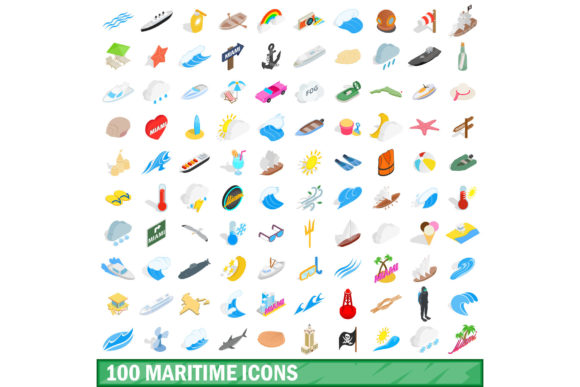
In an era where digital communication is dominated by visual storytelling, the ability to convey complex nautical themes quickly and effectively is a crucial skill for designers, educators, and content creators. Whether you are building a website for a shipping logistics company, designing educational materials for marine biology students, or creating assets for a maritime-themed mobile game, the choice of visual elements plays a pivotal role in user engagement. This is where specialized asset libraries become indispensable tools in the creative workflow. Among these, the 100 Maritime Icons Set has emerged as a versatile resource, particularly when rendered in an isometric 3D style. This unique perspective offers depth and realism that flat design often lacks, making it ideal for modern UI/UX design, infographics, and detailed vector illustrations.
The transition from two-dimensional flat icons to three-dimensional isometric representations marks a significant shift in graphic design trends. Isometric art provides a pseudo-3D look without the complexity of full perspective distortion, allowing objects to appear tangible and interactive. When applied to maritime subjects—ranging from cargo ships and lighthouses to anchors and compasses—this style adds a layer of sophistication and clarity. The availability of this set in multiple formats, including JPG, EPS, AI, PSD, and PNG, ensures that professionals across various industries can integrate these assets seamlessly into their existing workflows, regardless of their preferred software ecosystem.
The Appeal of Isometric Design in Maritime Contexts
Isometric design is not merely an aesthetic choice; it is a functional one. In the context of maritime illustration, the primary challenge is often representing large, complex machinery and environments in a way that is easily understood at a glance. Traditional top-down views can obscure details, while front-facing perspectives can flatten the sense of scale. Isometric projection solves this by providing a consistent angle (typically 30 degrees) that allows viewers to see three sides of an object simultaneously.
For a 100 Maritime Icons Set, this means that every element—from a small lifebuoy to a massive container ship—is presented with volume and spatial awareness. This is particularly beneficial for:
- Logistics and Supply Chain Visualization: Companies dealing with global trade need to visualize ports, warehouses, and transport routes. Isometric icons help create clear, map-based interfaces that users can intuitively navigate.
- Educational Materials: Teachers explaining oceanography or naval architecture benefit from the clarity that 3D-like structures provide. Students can better understand the components of a vessel or the layout of a dock when they are depicted with depth.
- Gaming and App Development: Strategy games and simulation apps often rely on isometric views to manage resources and units. A cohesive set of maritime icons ensures visual consistency throughout the application.
Technical Versatility Across File Formats
One of the most significant advantages of acquiring a comprehensive icon set like the 100 Maritime Icons Set is its technical flexibility. The inclusion of multiple file formats caters to different stages of the design process and varying technical requirements. Understanding how to leverage each format is key to maximizing the utility of these assets.
Vector Formats: EPS, AI, and SVG Readiness
The EPS (Encapsulated PostScript) and AI (Adobe Illustrator) files are the backbone of scalable vector graphics. These formats allow designers to resize icons from a tiny favicon to a billboard-sized banner without any loss of quality. For professional illustrators working in Adobe Creative Cloud, the AI file is native and editable, allowing for color customization, shape modification, and integration into larger compositions. EPS files, being a standard interchange format, ensure compatibility with older systems or other vector-based software like CorelDRAW. This scalability is essential for responsive web design, where icons must adapt to various screen sizes while maintaining crisp edges.
Raster Formats: PNG and JPG
While vectors offer infinite scalability, there are times when raster images are more practical or required. The PNG format is widely used for web design due to its support for transparency. This feature is critical when placing maritime icons over complex backgrounds, such as ocean textures or gradient skies, ensuring that the icon blends naturally without a harsh rectangular border. The JPG format, though lossy and lacking transparency, is useful for quick previews, email newsletters, or contexts where file size needs to be minimized for faster loading times. Having both options within the same set provides a balanced approach to asset management.
Layered Editing: PSD Files
The PSD (Photoshop Document) format offers another layer of utility. Unlike standard raster exports, PSD files often contain layered structures. This means that individual components of an icon—such as the mast, sails, and hull of a ship—might be separated into distinct layers. This allows for granular control, enabling designers to animate specific parts of an icon, change colors of individual elements, or isolate specific features for use in other projects. For educators creating dynamic presentations, this layering capability can turn static icons into engaging visual aids.
Comprehensive Coverage for Diverse Use Cases
A set containing 100 icons is substantial enough to cover a wide array of maritime topics, ensuring that users do not have to search for disparate sources to find related imagery. The 100 Maritime Icons Set typically encompasses several categories, each serving specific industry needs.
Nautical Symbols and Navigation
At the core of maritime identity are symbols associated with navigation and safety. This includes compasses, buoys, lighthouses, anchors, and sextants. These icons are foundational for any project related to sailing, exploration, or historical research. Their isometric rendering adds a tactile quality, making them feel like physical objects rather than abstract drawings. This is particularly effective in branding for yacht clubs, sailing schools, or adventure tourism companies.
Vessels and Transport
From small fishing boats to large cruise liners and container freighters, the variety of vessels represented in the set addresses the diversity of maritime transport. Each ship type carries specific connotations; a container ship implies commerce and efficiency, while a sailboat suggests leisure and tradition. By having these variations available in a consistent 3D style, designers can maintain visual harmony even when mixing different types of vessels in a single composition.
Maritime Infrastructure and Equipment
Ports, docks, cranes, and cargo containers are essential elements of the maritime industry. Isometric icons excel at depicting infrastructure because they can show the relationship between buildings, vehicles, and open space. This makes them perfect for designing dashboards for port management systems or creating infographics about global trade volumes. Additionally, equipment like life jackets, ropes, and nets adds detail and authenticity to scenes involving human activity on the water.
Best Practices for Implementation
To get the most out of the 100 Maritime Icons Set, it is important to adhere to certain best practices during implementation. Consistency is paramount. Since the icons are designed in an isometric 3D style, mixing them with flat icons or realistic photographs can create a disjointed visual experience. Designers should strive to use the entire set—or at least a subset from the same category—to maintain a unified aesthetic.
Color palette coordination is another consideration. While the set may come with default colors, adjusting hues to match brand guidelines is easy with vector files. However, it is advisable to keep the saturation levels and lighting effects consistent across all icons to preserve the 3D illusion. Over-saturating some icons while under-saturating others can break the perception of depth.
Furthermore, accessibility should not be overlooked. When using these icons in web design, ensure that they are accompanied by appropriate alt text. Describing the icon accurately helps screen readers interpret the content for visually impaired users. For example, instead of just "ship," use "isometric icon of a red container ship" to provide richer context.
Future Trends in Maritime Visual Communication
As technology evolves, so does the demand for high-quality visual assets. The trend towards immersive web experiences and augmented reality (AR) applications is likely to increase the value of 3D-style assets. While true WebGL models are becoming more common, isometric vector illustrations remain a lightweight and versatile alternative that loads faster and is easier to implement across different platforms. The 100 Maritime Icons Set positions itself well at the intersection of these trends, offering a bridge between traditional graphic design and emerging interactive media.
Educators and researchers will also find growing utility in these assets. As digital literacy becomes more prominent, the ability to create clear, visually appealing educational content is increasingly valued. Isometric diagrams are excellent for simplifying complex processes, such as the lifecycle of marine plastic pollution or the mechanics of wind energy generation at sea. The detailed nature of the icons supports narrative storytelling, allowing creators to guide the audience through a sequence of events with visual clarity.
Conclusion
The 100 Maritime Icons Set in isometric 3D style represents a significant resource for anyone involved in maritime-related design, education, or communication. Its combination of aesthetic appeal, technical versatility, and comprehensive coverage makes it suitable for a broad range of applications. By leveraging the strengths of vector and raster formats, and adhering to best practices in visual consistency and accessibility, professionals can create compelling, informative, and engaging content. As the digital landscape continues to evolve, high-quality, stylized assets like this set will remain essential tools for conveying the vast and complex world of the seas with clarity and impact.